

The Story Behind the WWII Marine Corps Physical Training Shirt
"Before moisture-wicking fabric... before unit PT shirts... before every Marine owned a drawer full of green skivvy shirts... there was one simple design that became part of building the Greatest Generation of Marines."
It wasn't expensive.
It wasn't fashionable.
It wasn't designed to stand out.
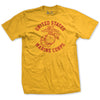
An olive drab cotton shirt.
Black ink.
An Eagle, Globe, and Anchor.
Four simple words.
U.S. MARINE CORPS
Thousands of young Americans wore that shirt while preparing for one of history's greatest tests.
Some would fight on Guadalcanal.
Others on Tarawa.
Peleliu.
Saipan.
Iwo Jima.
Okinawa.
Many would never come home.
But before they became combat veterans...
They all started in a shirt that represented something far greater than itself.
It represented the process of becoming a Marine.
Building a Wartime Marine Corps
When the United States entered World War II following the attack on Pearl Harbor, the Marine Corps faced an unprecedented challenge.
In 1940, the Corps numbered fewer than 30,000 Marines.
By the end of the war, more than 475,000 Marines had served.
Recruit depots at Parris Island and San Diego transformed ordinary civilians into disciplined fighting Marines at a pace the Corps had never experienced before.
Every day followed a demanding routine.
Long hours.
Relentless discipline.
Constant repetition.
The goal wasn't simply to improve physical fitness.
It was to build confidence, resilience, teamwork, and discipline under pressure.
The physical training shirt became part of that daily routine.
Simple.
Functional.
Purpose-built.
Just like the Marines wearing it.
Sweat Before the Battle
Today's Marines have moisture-wicking fabrics, performance apparel, and advanced athletic gear.
The Marines of World War II had cotton.
And determination.
Physical training looked different in the 1940s.
Recruits spent their days:
- Running formation miles.
- Climbing rope towers.
- Crossing obstacle courses.
- Carrying heavy equipment.
- Learning close-order drill.
- Building endurance through repetition.
Every exercise had one purpose:
To prepare Marines for the realities of combat.
That simple olive drab shirt absorbed sweat through countless workouts long before it ever became a symbol of history.
More Than an Eagle, Globe & Anchor
Front and center on the shirt was the Eagle, Globe & Anchor.
By World War II, the EGA had already become the enduring symbol of the United States Marine Corps.
Its origins stretch back to the nineteenth century, when the Corps adopted an emblem that reflected three defining ideals:
- The Eagle represented the United States.
- The Globe symbolized worldwide service.
- The Fouled Anchor honored the Corps' naval heritage.
While small artistic details of the emblem have changed over the decades, its meaning has never wavered.
Duty.
Honor.
Worldwide readiness.
For recruits, seeing that emblem on their training shirt wasn't just decoration.
It was a daily reminder of the title they had not yet earned.
A Shirt Earned Through Sweat
No Marine remembers the number of push-ups.
Or every mile they ran.
But they remember the feeling.
The exhaustion.
The Drill Instructor's voice.
The smell of boot leather and canvas.
The pride that slowly replaced uncertainty.
That shirt became part of those memories.
Not because it was unique.
Because everyone wore it.
It erased differences.
Rich or poor.
Farm kid or city kid.
College graduate or high school dropout.
Inside recruit training, everyone started the same.
Why We Brought It Back
At Leatherneck For Life, we didn't recreate this design because vintage military graphics are popular.
We recreated it because it represents something worth preserving.
It reminds us that greatness is rarely glamorous.
That discipline comes before confidence.
That tradition is earned, not inherited.
And that every Marine—whether they trained in World War II or graduated last year—belongs to the same unbroken legacy.
Some designs are more than artwork.
They're pieces of Marine Corps history.
Carrying the Legacy Forward
The Marines who wore this design during World War II helped liberate islands across the Pacific.
They fought in some of the fiercest battles in our nation's history.
They built the reputation every Marine has inherited since.
Today, wearing this design isn't about pretending to have served in another era.
It's about remembering those who did.
Because preserving Marine Corps heritage doesn't happen in museums alone.
It happens every time a story is told.
Every time a tradition is remembered.
And every time a Marine chooses to carry that legacy forward.
Leatherneck For Life
At Leatherneck For Life, every design begins with a story.
This WWII Physical Training design is our tribute to the Marines who trained, sweated, and sacrificed to become the generation that helped change the course of history.
Some shirts are just apparel.
Some carry a legacy.
Semper Fidelis.
CLICK HERE TO SEE OUR HERITAGE COLLECTION



2 comments
David Holder
USMC 60 to 64 Air Wing, Kaneohe, Cherry Point. Semper Fi Marines
William Santo
USMC 1961 to 1966. Vietnam vet!